
MIT Sloan School of Management
The digitization of the economy is one of the most critical issues of our time. While digital technologies are rapidly transforming both business practices and societies and are integral to the innovation driven economies of the future, they are also the core driver of the great economic paradox of our time. On one hand, productivity, wealth, and profits are each at record highs; on the other hand, the median worker in America is poorer than in 1997, and fewer people have jobs. Rapid advances in technology are creating unprecedented benefits and efficiencies, but there is no economic law that says everyone, or even a majority of people, will share in these gains. While technology is advancing rapidly, organizations and skills advance slowly. What’s more, the gap between swiftly evolving technology and the slower pace of human development will grow quickly in the coming decades, as exponential improvements in artificial intelligence, robotics, networks, analytics, and digitization affect more and more of the economy and society. Inventing effective organizations and institutions for the digital economy is the grand challenge for our time, and for MIT in particular.
The Initiative for the Digital Economy
The Initiative for the Digital Economy (IDE) is a major effort addressing the impact of digital technology on businesses, the economy, and society. Drawing upon MIT Sloan’s strengths in technology and innovation, its internationally recognized faculty, and over a decade of research and partnership with MIT Sloan’s Center for Digital Business, the new Initiative will analyze the broad sociological changes brought about by digital technology. Many of the key issues are described in a recent book by Professor Erik Brynjolfsson and Dr. Andrew McAfee, Race Against the Machine - How the Digital Revolution is Accelerating Innovation, Driving Productivity, and Irreversibly Transforming Employment and the Economy. In the book, they outline the relevant issues the new initiative will address, as follows:
MIT Sloan, with its tradition of combining rigor and relevance, is uniquely qualified to lead intellectually in this area and, indeed, has a responsibility to do so. Embracing the MIT mission, to bring knowledge to bear on the world’s great problems, and the MIT Sloan mission, to develop principled, innovative leaders who improve the world and to generate ideas that advance management practice, this Initiative has three main goals:
Support
Partnership with MIT and MIT Sloan alumni and friends is critical to the success of this Initiative. Expanded funding will enable a new wave of faculty hiring, curriculum development, fellowships, and will support additional groundbreaking research by our faculty and graduate students. In order for MIT and MIT Sloan to be successful in this area, there must be this organized initiative to focus attention, resources, and energy. If we are successful, we can have a truly meaningful impact on living standards, employment, and society.
Leadership
Erik Brynjolfsson is the Director of the MIT Center for Digital Business, the Schussel Family Professor of Management at MIT Sloan, and Chairman of the MIT Sloan Management Review. His research examines the effects of information technologies on business strategy, productivity and performance, Internet commerce, pricing models, and intangible assets. At MIT, he teaches courses on the Economics of Information. Professor Brynjolfsson was among the first researchers to measure the productivity contributions of IT and the complementary role of organizational capital and other intangibles. His research also provided the first quantification of the value of online product variety and developed pricing and bundling models for information goods. Brynjolfsson’s research has appeared in leading economics, management, and science journals, and has been recognized with nine Best Paper awards and five patents. Professor Brynjolfsson holds Bachelors and Masters degrees from Harvard University in Applied Mathematics and Decision Sciences and a PhD from MIT in Managerial Economics. He has also taught at Harvard and Stanford.
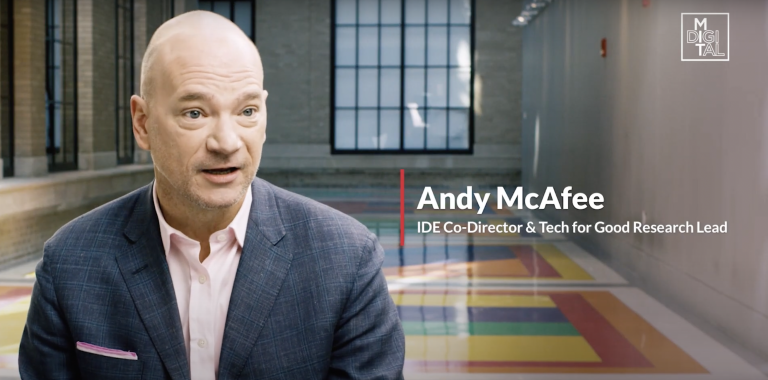
Andrew McAfee is the Associate Director and Principal Research Scientist at the MIT Center for Digital Business. His research investigates how information technology (IT) changes the way companies perform, organize themselves, and compete. At a higher level, his work also focuses on how computerization affects competition, society, the economy, and the workforce. In addition to having numerous papers published, Professor McAfee also writes a blog, which is widely read, becoming at times one of the 10,000 most popular in the world. He received his Doctorate from Harvard Business School, and completed two Master of Science and two Bachelor of Science degrees at MIT. He speaks frequently to both academic and industry audiences, and has taught in executive education programs around the world.
Both Brynjolfsson and McAfee are digital optimists, noting that even as Americans listed ‘jobs and unemployment’ as the country’s most pressing problem, corporate investments in software and equipment have reached a historic peak as innovation is accelerating. The past decade has had the strongest productivity growth since the 1960s.
With this Initiative, Brynjolfsson and McAfee will bring MIT Sloan thought leadership to address the workplace transformations and prospects for growth brought by digital technology. Digital advancement, Brynjolfsson says, is “creating trillions of dollars of wealth as it increases productivity, and that’s good news.” However, he continues, “our skills and our organizations need to adapt faster to keep up with the new technologies – and so must MIT Sloan.” With the generous support of individual, foundation, and corporate philanthropy, IDE willocus its resources on these opportunities and pressures..
Erik Brynjolfsson, Schussel Family Professor of Management Science,
Director of the MIT Center for Digital Business
For more information:
MIT Sloan Office of External Relations
1-617-253-1557 | MITSloanAlumniRelations@mit.edu
On the Web at: http://digital.mit.edu/index.htm